
Last updated: 22 October 2026
Affiliate Disclosure: This page contains affiliate links. If you buy through these links, we may earn a small commission at no extra cost to you. Learn more
The best bedding for hot sleepers UK buyers can choose comes down to materials far more than brand names or cooling claims. Almost every guide on this subject is published by a company selling its own bedding, which makes it hard to get a straight answer on what genuinely works. This one compares the options layer by layer — sheets, duvet, pillow and mattress surface — and is honest about where the trade-offs are.
The short version: natural breathable fibres beat synthetics for anything touching your skin, a lower tog matters more than any cooling treatment on a duvet, and no bedding will fix a bedroom that is simply too warm.
| Key Takeaways • Linen, bamboo and Tencel are the strongest sheet materials for hot sleepers. Polyester and microfibre are the ones to avoid. • On duvets, tog rating does more work than any cooling finish — a 4.5 tog summer duvet beats a treated 10.5 tog one on a hot night. • Changing your sheets is the cheapest change and usually the most noticeable. • Bedding can only do so much. If the room itself is hot, you need airflow or active cooling as well. |
Why Materials Matter More Than Products
Independent sources agree closely on this, which is unusual. Linen, bamboo viscose and Tencel consistently come out on top for hot sleepers because all three are breathable and move moisture away from the skin rather than holding it against you. Cotton percale is a solid, cheaper alternative. Polyester and microfibre sit at the bottom: they trap both heat and moisture, which is exactly the combination that wakes people up at 3am.
This matters because cooling marketing is applied to all sorts of materials, including ones that are poor choices to begin with. A cooling finish on a synthetic sheet is still a synthetic sheet. Start with the fibre, then look at the treatments.
| Material | Breathability | Moisture handling | Best for |
| Linen | Excellent | Absorbs a high share of its weight in moisture | Hot sleepers who don’t mind a crisp, textured feel |
| Bamboo viscose | Excellent | Excellent, wicks well | Those wanting linen-like cooling with a softer feel |
| Tencel (lyocell) | Excellent | Excellent | A smooth alternative to bamboo |
| Cotton percale | Very good | Good, absorbent | An easy, affordable everyday choice |
| Wool | Very good | Highly absorbent, temperature-regulating | Year-round duvets and toppers |
| Cotton sateen | Moderate | Good | People who want a silkier finish and run only slightly warm |
| Polyester / microfibre | Poor | Poor, traps moisture | Best avoided as a sheet material if you sleep hot |
Where to Spend, Layer by Layer
If you’re not replacing everything at once — and most people aren’t — the order you tackle things in makes a real difference to how much cooler the bed feels for the money.
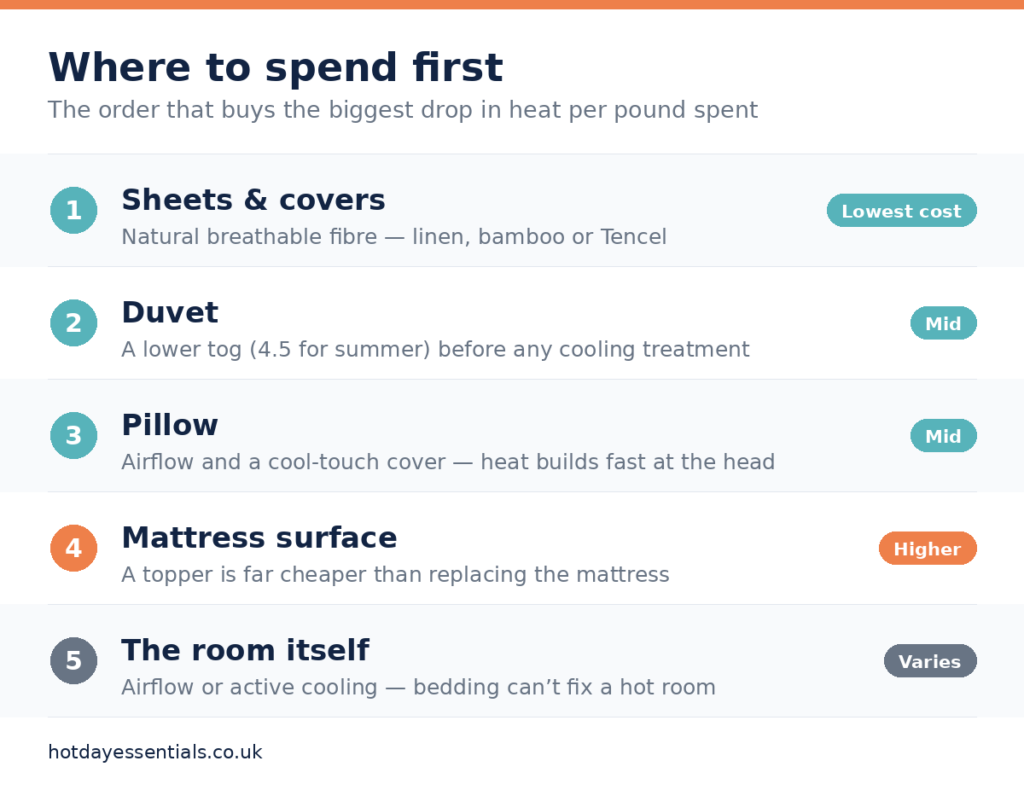
| Layer | What to prioritise | Rough spend |
| Sheets & covers | Natural breathable fibre — linen, bamboo or Tencel | Lowest cost, biggest immediate difference |
| Duvet | A lower tog (4.5 for summer) before any cooling treatment | Mid |
| Pillow | Airflow and a cool-touch cover; heat builds fast at the head | Mid |
| Mattress surface | A topper is far cheaper than replacing the mattress | Higher |
| The room itself | Airflow or active cooling — bedding can’t fix a hot room | Varies |
Sheets and Duvet Covers — Start Here
Sheets are in direct contact with your skin all night, so the fibre choice has more immediate effect than anything else on this page, and it’s usually the cheapest layer to change. Linen is the standout: it is highly breathable, absorbs a significant share of its own weight in moisture, and gets softer with washing rather than wearing out.
Simba’s Cool Linen bedding is the option we’ve looked at in detail — full write-up in our Simba Cool Linen Bedding Bundle review. Check current price.
| Worth knowing Linen feels crisp and textured out of the packet and takes several washes to soften. If you prefer a smooth feel from night one, bamboo viscose or Tencel give similar cooling performance without the breaking-in period. |
Duvets — Tog Rating First, Cooling Tech Second
The single most effective change to a duvet is dropping the tog. A 4.5 tog summer duvet will outperform a 10.5 tog duvet with a cooling cover on a warm night, because there is simply less insulation between you and the room. Many people use one 10.5 tog duvet all year without realising that’s the cause of their summer discomfort.
Here is the honest trade-off on the most widely sold cooling duvets, Simba’s included: the fill is recycled polyester rather than a natural fibre like wool or down, and synthetic fills are less breathable than naturals. What you get in exchange is a cool-touch treated cover, machine washability, and in the case of the standard Hybrid duvet, GenM Menopause Friendly accreditation for helping with night sweats. Whether that trade is worth it depends on how much you value washability and the lower price against raw breathability.
For hot sleepers the Summer Hybrid at 4.5 tog is the one that matters; the 10.5 tog Hybrid is the year-round option and the Hybrid 3-in-1 splits into lighter layers by season. All three are compared in our Simba duvet comparison.
Pillows — Where Heat Builds Fastest
A lot of overheating is concentrated at the head, and a pillow that holds heat will wake you even when the rest of the bed is comfortable. Look for airflow through the fill and a cool-touch cover, and be wary of solid memory foam, which is among the worst offenders for trapping heat.
Simba sells two: the adjustable Hybrid Pillow at £109, and the simpler AeroDown Pillow at £60, which has a confirmed machine washable cover. Both are compared in our Simba pillow comparison.
The Mattress Surface — a Topper Before a New Mattress
If the mattress itself is holding heat, a topper is the sensible first move. It costs a fraction of a new mattress, changes the surface you actually lie on, and can be removed in winter if you want the warmth back.
Our Simba Cool Foam mattress topper review covers how it performs. Check current price.
Cooling the Room, Not Just the Bed
This is the limit of what bedding can do. If your bedroom holds heat through the night — a west-facing room, a top-floor flat, a loft conversion — then breathable sheets will make you more comfortable but they will not make the room cooler. At that point you need to move air or remove heat.
Two routes are worth reading on: a portable evaporative cooler, which is cheaper to run but works best in drier air, or a portable air conditioner, which costs more but cools properly in any humidity. For immediate relief without any equipment, a cooling towel is the low-cost option.
A Note on Night Sweats
Night sweats are a common reason people search for cooling bedding, including during perimenopause and menopause. We won’t pretend to personal experience of that here, so this section sticks to what can be verified.
Independent guidance consistently points to naturally breathable, moisture-absorbing materials — wool and linen in particular — as the most effective option, because absorbing perspiration matters as much as feeling cool to the touch. Separately, GenM is an independent certification body that assesses products against menopause-specific needs; Simba’s Hybrid Duvet and both of its pillows carry its Menopause Friendly accreditation for helping alleviate night sweats. That accreditation is a fact about the products rather than a claim we’re making about how they will feel for any individual.
If night sweats are frequent, severe or new, that is worth raising with a GP rather than solving with bedding alone.
Honest Limitations
- We haven’t tested this bedding ourselves — these recommendations are built from manufacturer specifications and independent UK reviews, not our own hands-on testing.
- The Simba duvets and pillows recommended here use recycled polyester fill, which is less breathable than wool, down or linen. They compensate with cool-touch covers, washability and accreditation, but we’d be overstating it to call a synthetic fill the most breathable option available.
- Prices change frequently and Simba runs regular sales, so check the live price before buying.
- How hot you sleep is affected by your mattress, room temperature, ventilation and health factors as well as bedding — changing sheets alone may not be enough.
- We cover Simba in depth because we have looked at their range closely; this is not a claim that no other brand performs as well.
Quick Decision Guide
| If… | Because… | |
| Start with sheets | You haven’t changed your bedding materials yet — this is the cheapest change with the clearest effect. | Cool Linen bedding |
| Change the duvet | You’re using one duvet all year and overheat in summer. A 4.5 tog summer duvet is the fix. | Summer Hybrid Duvet |
| Change the pillow | You wake up with a hot head and damp pillow but are otherwise comfortable. | Simba pillows |
| Add a topper | Your mattress itself holds heat and replacing it isn’t realistic. | Cool Foam Topper |
Frequently Asked Questions
What is the best bedding material for hot sleepers?
Linen is the most consistently recommended, with bamboo viscose and Tencel close behind. All three are breathable and move moisture away from the skin. Cotton percale is a good cheaper alternative, while polyester and microfibre are the materials to avoid.
What tog duvet should a hot sleeper use in summer?
Around 4.5 tog is the usual recommendation for summer. If you currently use a single 10.5 tog duvet year-round, that is the most likely reason you overheat in warm weather, and dropping the tog will do more than any cooling treatment.
Do cooling bedding products actually work?
Cool-touch treatments and breathable fibres make a measurable difference to how the bed feels, but none of them cool the way a fan or an air conditioner does. Think of them as reducing heat build-up rather than actively chilling you.
Is bamboo bedding better than linen?
They perform similarly on cooling. Bamboo feels smooth and soft immediately, while linen is crisp and textured and takes several washes to soften, so the choice is mostly about the feel you prefer.
What should I change first if I sleep hot?
Sheets. They are the cheapest layer to replace, they are in direct contact with your skin all night, and switching from a synthetic to a breathable natural fibre usually gives the most noticeable improvement for the money.
Related Articles
Best Simba Duvet UK: Summer Hybrid vs Hybrid vs 3-in-1
Best Simba Pillow UK: Hybrid vs AeroDown
Simba Cool Linen Bedding Bundle Review UK
Simba Cool Foam Mattress Topper Review UK
Best Portable Evaporative Cooler UK 2026
Sources
Simba Sleep official UK product pages; independent bedding guidance from Ideal Home, the Sleep Foundation and UK bedding retailers; GenM Menopause Friendly accreditation listings.
| About the Author Mark writes HotDayEssentials.co.uk, a UK site dedicated to testing and comparing warm-weather and outdoor comfort gear. Product picks are based on published specifications, verified UK availability, and a review of genuine customer feedback. |